Pokémon cards may look small, but their dimensions matter more than many collectors realize. Whether you are building a collection, buying protective sleeves, organizing a binder, or checking a rare card, knowing the correct measurements can help you avoid costly mistakes.
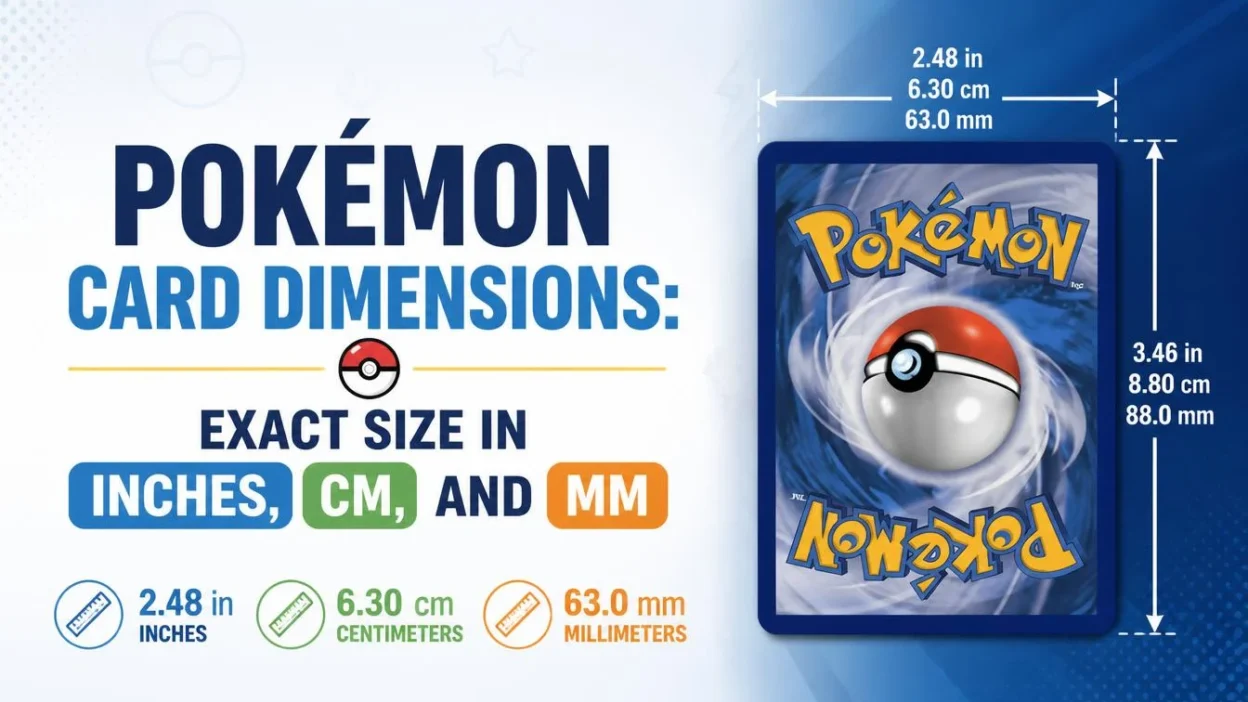
A standard Pokémon trading card measures approximately 2.5 inches wide and 3.5 inches tall. In metric measurements, that is about 6.35 cm × 8.89 cm, commonly rounded to 63 × 88 mm by card-accessory manufacturers. These dimensions are used for regular Pokémon Trading Card Game cards in English, Japanese, and other languages. <Cite refs={[“turn907132search3″,”turn907132search5”]}/>
However, standard cards are not the only type collectors encounter. Jumbo promotional cards are much larger, graded cards sit inside protective cases, and sleeves need extra space around the card to make insertion easy.
In this guide, you will learn the standard Pokémon card size, measurements in different units, suitable sleeves and holders, the difference between regular and jumbo cards, and how to measure a card accurately.
What Are the Standard Pokémon Card Dimensions?
A regular Pokémon card follows the familiar trading-card format used by many collectible card games. Its rectangular shape makes it easy to shuffle, store, display, and protect.
Here is a quick breakdown of the standard measurements.
| Measurement | Dimensions |
|---|---|
| Width | 2.5 inches |
| Height | 3.5 inches |
| Width in centimeters | 6.35 cm |
| Height in centimeters | 8.89 cm |
| Approximate width in millimeters | 63–63.5 mm |
| Approximate height in millimeters | 88–88.9 mm |
| Approximate thickness | 0.3 mm |
The commonly used 2.5 × 3.5-inch measurement converts mathematically to 63.5 × 88.9 mm. Some references and accessory manufacturers round these values to 63 × 88 mm. This small difference reflects rounding and measurement conventions rather than a different standard card format. <Cite refs={[“turn907132search3″,”turn907132search5”]}/>
The width is the shorter side, while the height is the longer side when you hold the card upright. This distinction is especially useful when ordering sleeves or designing storage compartments.
Pokémon Card Size in Inches
Inches are a convenient way to understand card dimensions, particularly if you live in the United States or purchase accessories from American retailers.
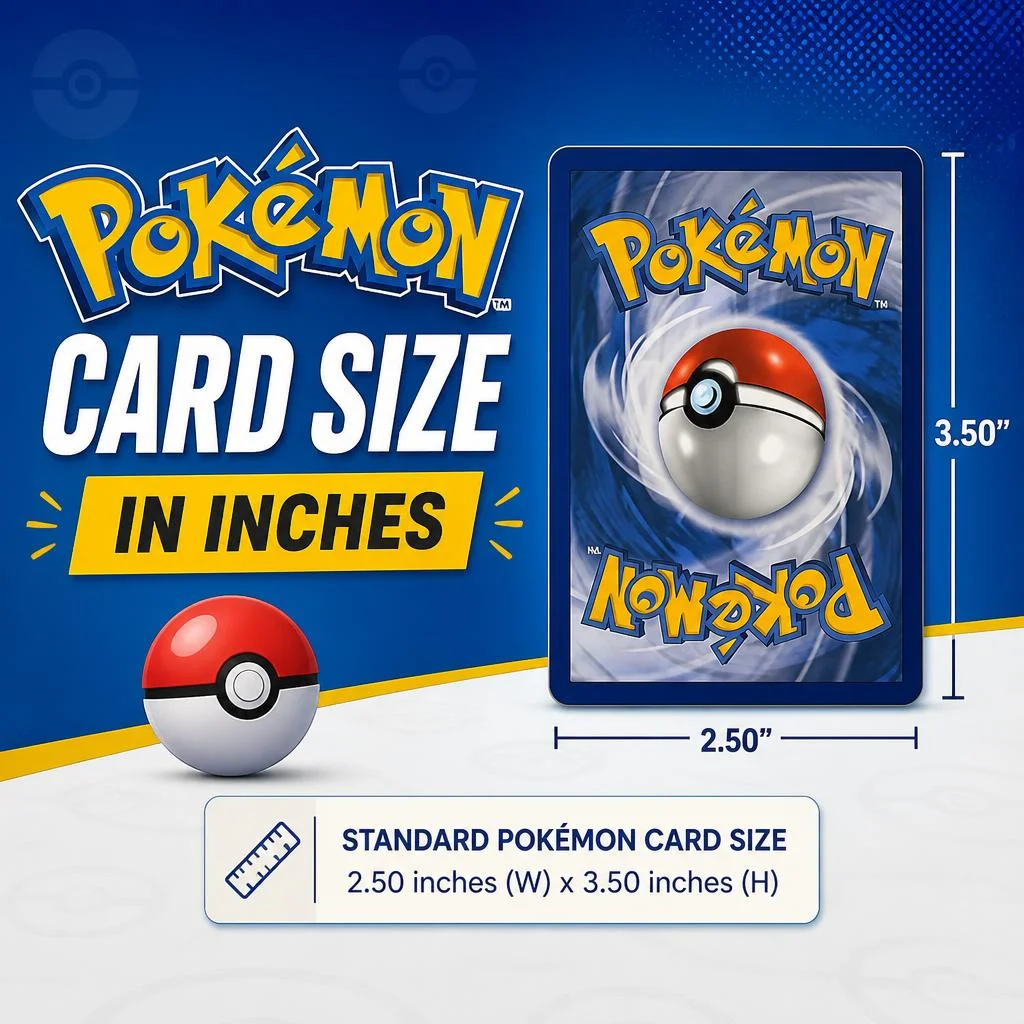
A standard Pokémon card is approximately:
- Width: 2.5 inches
- Height: 3.5 inches
- Shape: Vertical rectangle with rounded corners
Imagine a card that measures two and a half inches from left to right and three and a half inches from top to bottom. That is the approximate size you will find in an ordinary booster pack.
The 3.5-inch height gives the card enough room for its artwork, name, attacks, energy symbols, and other game information. Meanwhile, the 2.5-inch width keeps it compact enough to hold comfortably in one hand.
These dimensions also explain why Pokémon cards fit many standard trading-card accessories. Nevertheless, you should always check whether an accessory listing describes the card it fits or the outside dimensions of the sleeve or holder itself.
Pokémon Card Dimensions in CM and MM
Metric measurements are useful when buying accessories internationally or working with precise storage dimensions.
| Unit | Width | Height |
|---|---|---|
| Inches | 2.5 in | 3.5 in |
| Centimeters | 6.35 cm | 8.89 cm |
| Millimeters | 63.5 mm | 88.9 mm |
| Common rounded reference | 63 mm | 88 mm |
If you are measuring a card with a ruler marked in centimeters, expect the width to be close to 6.35 cm and the height to be close to 8.89 cm. Small differences may occur because of manufacturing tolerances, wear, or the accuracy of the measuring tool.
For most everyday purposes, you do not need to worry about a fraction of a millimeter. If you are ordering a custom holder or creating a snug storage insert, however, leave a little clearance rather than designing the compartment to the exact nominal card dimensions.
How Thick Is a Pokémon Card?
A standard Pokémon card is approximately 0.3 millimeters thick, although the precise thickness can vary slightly between cards and production types. <Cite refs={[“turn907132search0″,”turn907132search3”]}/>
That is much thinner than a typical plastic card. Pokémon cards use a printed paper-based construction with multiple layers, which gives them flexibility while maintaining enough structure for regular gameplay.
Thickness becomes particularly important when storing a large collection. A single card takes up very little space, but hundreds of cards can create a substantial stack.
For example, if 30 cards each measure approximately 0.3 mm thick, their combined thickness would be around 9 mm before accounting for variation and compression. A thick stack can therefore add up quickly even though each individual card feels thin.
Foil finishes, card condition, and manufacturing differences may influence the thickness slightly. For that reason, treat 0.3 mm as an approximate reference rather than an exact specification for every card.
Are English and Japanese Pokémon Cards the Same Size?
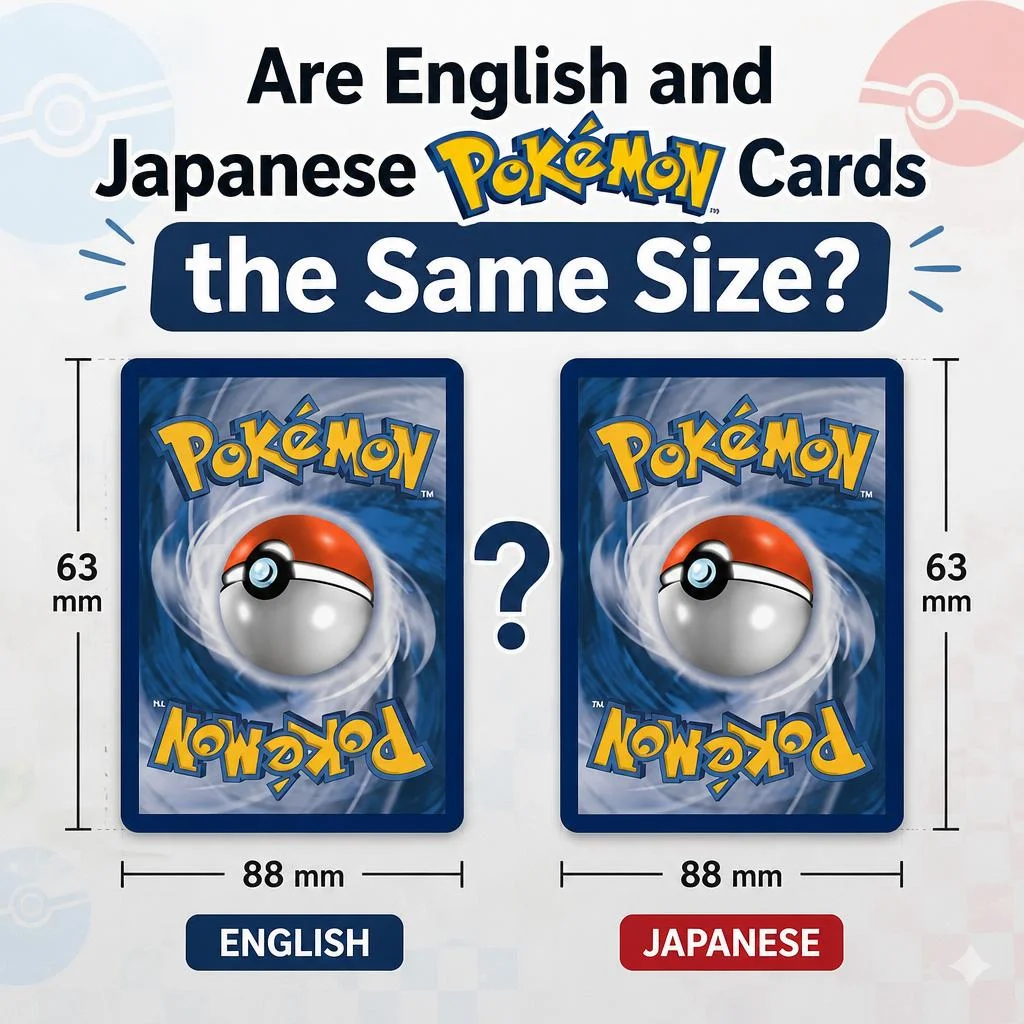
Yes. Standard English and Japanese Pokémon cards use the same general dimensions, approximately 2.5 × 3.5 inches. Collectors can normally use the same standard-size sleeves for both versions. <Cite refs={[“turn907132search0″,”turn907132search1”]}/>
This is useful for people who collect cards from different regions. You can organize English and Japanese cards together in the same standard-size binder without needing a separate card format.
The confusion often comes from the phrase “Japanese-size sleeves.” These sleeves are generally designed for smaller cards used by games such as Yu-Gi-Oh!, not for Japanese Pokémon cards. They can be too narrow for Pokémon cards.
Before buying protective sleeves, look for wording such as “standard size” and confirm that the product specifically lists Pokémon or cards measuring approximately 63 × 88 mm.
What Size Sleeves Fit Pokémon Cards?
Protective sleeves help prevent scratches, dirt, fingerprints, and everyday handling damage. The right sleeve should hold the card securely without making insertion difficult.
The best size depends on whether you want a close-fitting inner sleeve, a regular deck sleeve, or a rigid protective holder.
| Accessory type | Approximate size | Main purpose |
|---|---|---|
| Perfect-fit inner sleeve | Around 64 × 89 mm | Close fit directly around the card |
| Standard outer sleeve | Around 66 × 91 mm | Everyday protection and gameplay |
| Toploader | Commonly sold for 3 × 4-inch cards | Rigid protection and display |
| Binder pocket | Varies by manufacturer | Organized collection storage |
These are approximate accessory sizes; actual internal dimensions and compatibility depend on the product. A toploader’s advertised outside measurements may be larger than its usable interior. <Cite refs={[“turn907132search0″,”turn907132search1”]}/>
Perfect-Fit Sleeves
Perfect-fit sleeves are designed to sit closely around an individual card. Collectors often use them as the first layer of a double-sleeving setup.
Because these sleeves leave very little extra room, they can be more difficult to use if the dimensions are too tight. Never force a card into a sleeve that catches on its corners or edges.
Standard Card Sleeves
Standard sleeves offer a little more room than close-fitting inner sleeves. They are a practical choice for cards used in games, casual collections, and regular binder storage.
If you want one simple option for everyday Pokémon cards, standard-size sleeves labeled for Pokémon TCG are a sensible starting point.
Toploaders
Toploaders are rigid plastic holders that protect individual cards from bending and handling damage. A common option is a 3 × 4-inch toploader designed for standard trading cards.
Collectors frequently place a card inside a soft sleeve before inserting it into a toploader. Check the holder’s specifications to ensure that the sleeved card fits without pressure.
Pokémon Card Size Compared With Other Trading Cards
Pokémon cards belong to the standard-size trading-card category. This makes them compatible with many accessories sold for other collectible card games.
| Card type | Approximate standard size | Sleeve compatibility |
|---|---|---|
| Pokémon TCG | 2.5 × 3.5 inches | Standard-size sleeves |
| Magic: The Gathering | 2.5 × 3.5 inches | Generally compatible |
| Standard sports cards | About 2.5 × 3.5 inches | Often compatible |
| Yu-Gi-Oh! | Smaller, around 2.3 × 3.4 inches | Usually requires smaller sleeves |
The measurements in the table are rounded references. Exact card dimensions can vary slightly by product, so check the sleeve manufacturer’s supported card list when fit is important. <Cite refs={[“turn907132search3″,”turn907132search5”]}/>
The key difference is that a sleeve designed for a smaller card may not accommodate a Pokémon card comfortably. A larger sleeve, on the other hand, may leave enough extra space for the card to slide around.
How Big Are Jumbo Pokémon Cards?

Jumbo Pokémon cards are promotional or collectible cards that are much larger than regular cards. They may appear in special collection boxes or promotional products and are usually intended for display rather than normal gameplay.
Unlike standard cards, jumbo cards do not all follow one universal size across every release. Older and newer promotional formats can differ, so measure the specific card before ordering a sleeve or frame. <Cite refs={[“turn907132search8″,”turn907132search9”]}/>
A jumbo card may look like an enlarged version of an ordinary Pokémon card, but its dimensions can make standard binders and deck sleeves unsuitable.
If you own a jumbo promo, measure its width and height independently. Then choose an oversized sleeve, binder page, or display case that allows a little extra room around the edges.
Do not assume that every jumbo card uses the same measurements simply because the artwork and layout resemble a standard card.
How to Measure a Pokémon Card Correctly
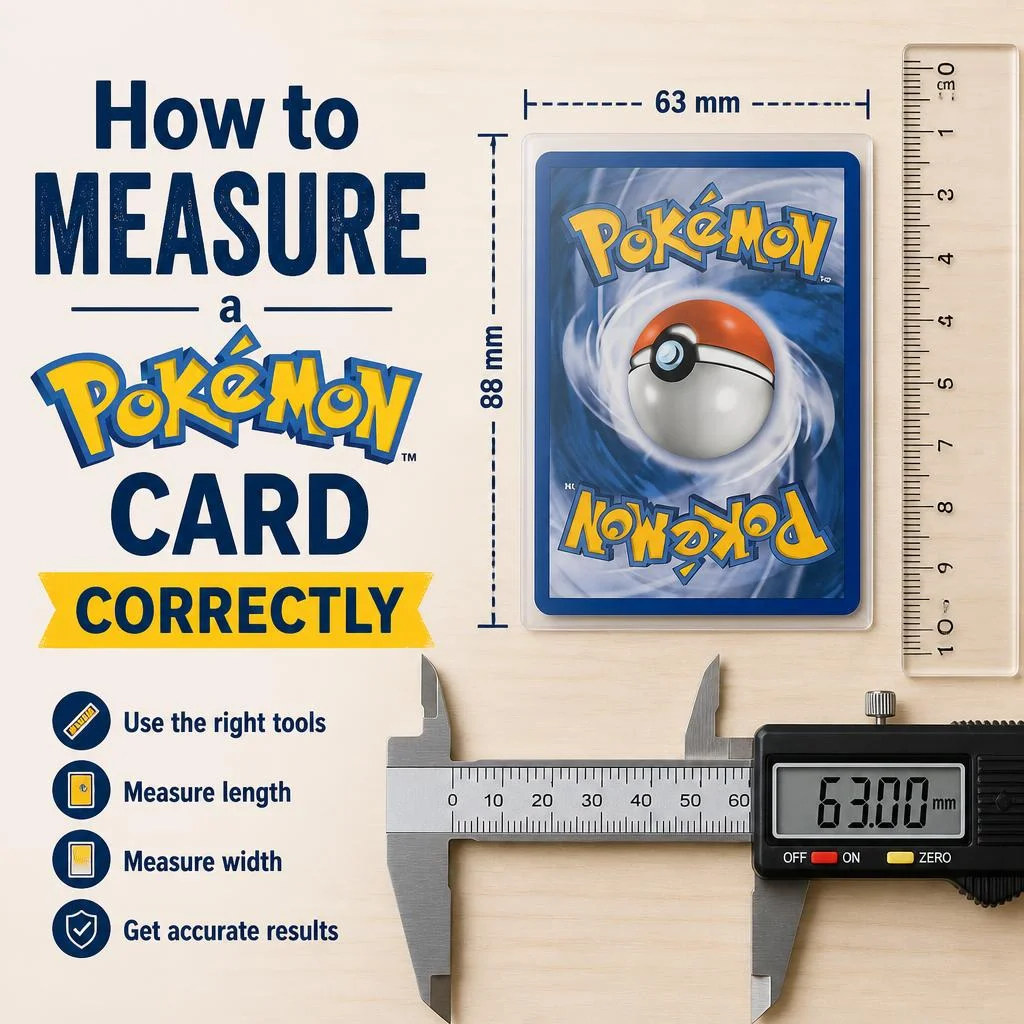
You can measure a Pokémon card at home with a ruler or digital caliper. For most collectors, a ruler with clear millimeter markings is enough.
Follow these steps:
- Place the card on a flat surface. This prevents a bent or curled card from affecting the reading.
- Measure the width. Place the ruler along the shorter edge, from one side to the other.
- Measure the height. Check the longer edge from the bottom to the top.
- Record the units. Write down the measurements in inches, centimeters, or millimeters.
- Check the thickness only if necessary. A digital caliper may be more useful than an ordinary ruler for this measurement.
Handle valuable cards carefully while measuring. Avoid pressing hard with a ruler or caliper, and do not bend the card to make it fit a measuring tool.
If a card appears noticeably smaller or larger than expected, do not assume that the measurement alone proves whether it is genuine. Wear, damage, trimming, measuring errors, and manufacturing variation can all affect dimensions. Authentication requires examining other features as well.
What Size Should a Pokémon Card Binder Be?
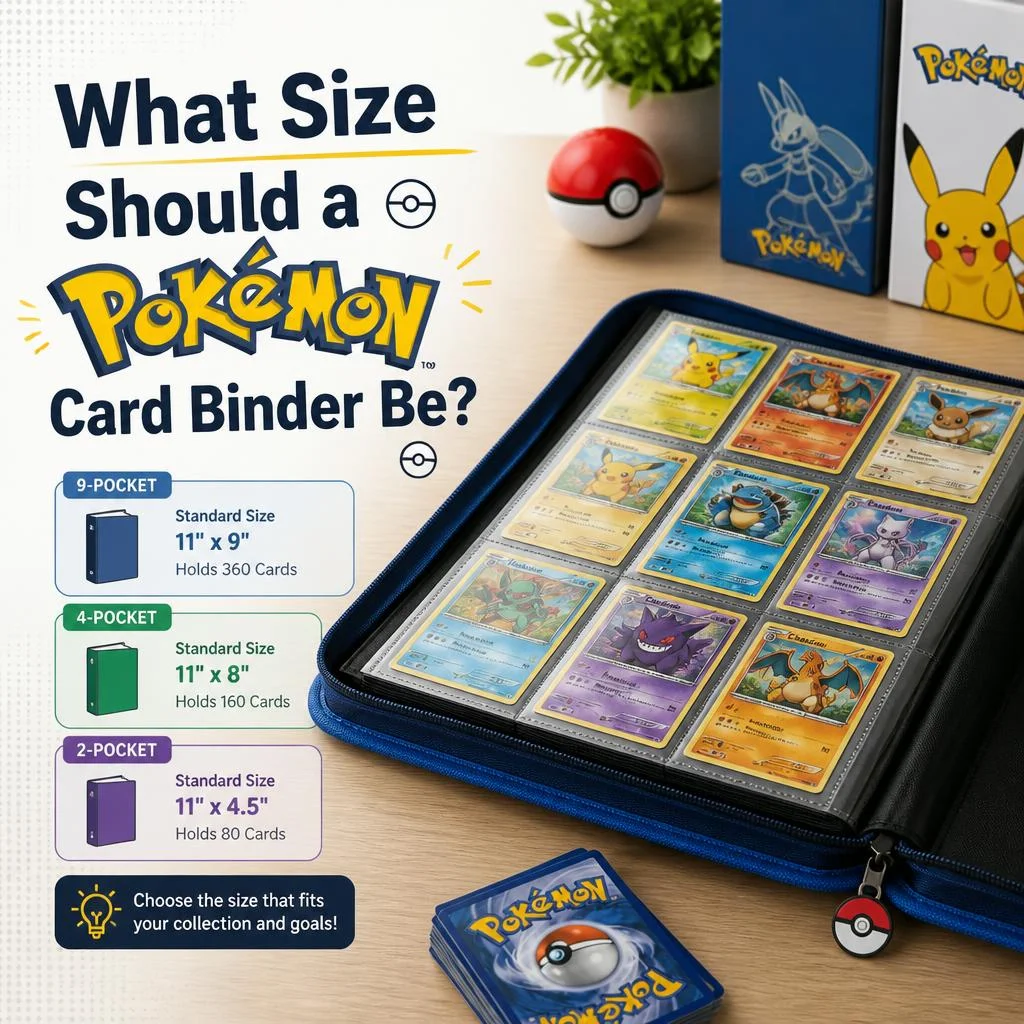
Most standard Pokémon cards fit binders designed for regular trading cards. Many collectors choose nine-pocket pages because they make it easy to view cards in rows and organize a collection by set, type, rarity, or Pokédex number.
Before buying a binder, check the pocket dimensions rather than relying only on the number of pockets. Some pages have tighter openings than others, and double-sleeved cards may fit less comfortably.
Consider these points when choosing a binder:
- Pocket fit: Standard cards should slide in without bending or catching.
- Sleeve allowance: Make sure the pockets accommodate your chosen sleeves.
- Page capacity: Decide how many cards you want to store in one binder.
- Protection: A sturdy cover and secure closure help protect the collection.
- Card type: Jumbo promos require oversized pages or a separate storage solution.
If you store valuable cards, use products designed to protect trading cards and avoid overcrowding the pockets. For cards you handle frequently, easy access and secure storage are both important.
Pokémon Card Dimensions for Printing and Custom Designs
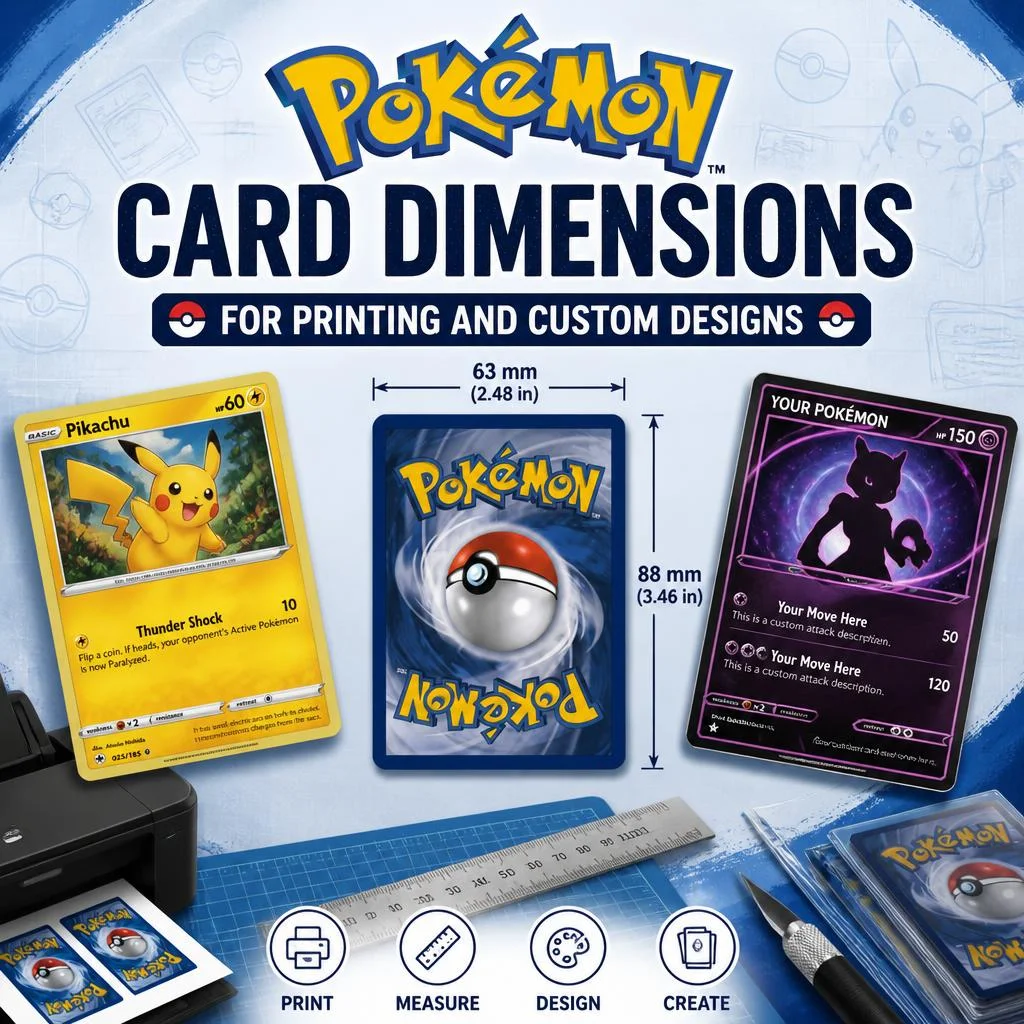
If you are creating a custom card-shaped design, the standard finished card size is approximately 2.5 × 3.5 inches.
For a digital design intended for printing at 300 DPI, a canvas measuring 750 × 1,050 pixels corresponds to 2.5 × 3.5 inches. This calculation is based on the usual 300 pixels per inch setting.
However, the finished card size and the full print file size are not necessarily the same. Professional printing may require extra artwork beyond the cutting line, known as bleed. Important text and artwork also need a safe margin so they are not cut off.
For that reason, follow the printer’s template if you are producing custom trading cards. A file sized only to the finished dimensions may not provide enough space for trimming.
If you are making fan art or a personal project, remember that Pokémon names, characters, logos, and official card artwork are protected intellectual property. Make sure your intended use complies with applicable rights and permissions.
Frequently Asked Questions About Pokémon Card Dimensions
1. What are the exact dimensions of a Pokémon card?
A standard Pokémon card is commonly described as 2.5 inches wide by 3.5 inches tall, or approximately 6.35 × 8.89 cm. Some references round the metric measurements to 63 × 88 mm. <Cite refs={[“turn907132search3″,”turn907132search5”]}/>
2. Are Pokémon cards 2.5 × 3.5 inches?
Yes. That is the standard rounded size used for regular Pokémon trading cards and their accessories.
3. How many centimeters is a Pokémon card?
A standard card is approximately 6.35 cm wide and 8.89 cm tall.
4. Are Japanese Pokémon cards smaller than English cards?
No. Standard Japanese and English Pokémon cards use the same general dimensions. Sleeves labeled “Japanese size” may refer to a smaller card format used by other trading-card games. <Cite refs={[“turn907132search0″,”turn907132search1”]}/>
5. What size sleeves should I buy for Pokémon cards?
Choose standard-size sleeves that specifically list Pokémon TCG compatibility. Many regular sleeves measure approximately 66 × 91 mm, while perfect-fit inner sleeves are smaller. Check the product’s fit specifications before buying.
6. How thick is a standard Pokémon card?
A typical standard card is about 0.3 mm thick, although the precise measurement may vary slightly. <Cite refs={[“turn907132search0″,”turn907132search3”]}/>
7. Are jumbo Pokémon cards the same size as regular cards?
No. Jumbo promotional cards are substantially larger, and their measurements vary by release. Measure your particular card before purchasing an oversized sleeve or display holder.
8. Will Pokémon cards fit in a Magic: The Gathering binder?
Usually, yes. Both games use the standard trading-card format, but pocket dimensions can vary between binder brands. Check the binder specifications if your cards are double-sleeved.
9. Can card dimensions prove that a Pokémon card is fake?
No. Measuring the card can identify an obvious size discrepancy, but it cannot prove authenticity by itself. Other details, such as printing quality, card construction, and comparison with a verified card, also matter.
10. What pixel size should I use for a Pokémon card design?
For a 2.5 × 3.5-inch design at 300 DPI, use 750 × 1,050 pixels for the finished dimensions. Add bleed and safe margins according to your printer’s requirements.
Final Thoughts
The standard Pokémon card dimensions are approximately 2.5 inches wide by 3.5 inches tall, equivalent to 6.35 × 8.89 cm or roughly 63 × 88 mm. Regular English and Japanese cards use the same general format, making standard-size sleeves, binders, and many trading-card holders suitable for both.
The most important thing is to match the accessory to the card. Use standard sleeves for everyday cards, rigid holders for individual cards that need extra protection, and oversized storage for jumbo promotional cards.
Whether you are organizing a binder, protecting a rare pull, or designing a custom card layout, these measurements give you a reliable starting point. Check the actual product specifications whenever a particularly snug fit or precise measurement matters.

Aiden Cross is a passionate writer dedicated to exploring creativity, style, and modern trends through engaging and informative content. His goal is to provide readers with practical insights and fresh perspectives.