
Have you ever watched an NBA game and wondered how high the basketball hoop actually is? When players like LeBron James, Stephen Curry, and Victor Wembanyama shoot, dunk, or block shots, the rim can look surprisingly close to their hands. However, professional basketball requires players to reach a fixed target that has remained a standard part of the game for generations.
The official NBA hoop height is 10 feet (120 inches or 3.05 meters) above the playing surface. This measurement applies to every regulation NBA court, regardless of the arena, team, or player. Whether a game takes place in Los Angeles, Boston, or New York, the rim must meet the same height requirement.
But there is more to a basketball hoop than its height. The rim has a specific diameter, the backboard follows standard measurements, and the distance between the basket and the court affects shooting angles, dunking ability, and rebounding. Understanding these details helps explain why basketball is such a challenging sport.
In this guide, you will learn the official rim height, how it compares with other basketball levels, why the standard is 10 feet, and how to choose the right hoop height for younger players at home.
How High Is an NBA Hoop?
An NBA basketball hoop stands 10 feet above the floor, measured vertically from the playing surface to the top of the rim.
Here are the main measurements in different units:
| Measurement | NBA hoop height |
|---|---|
| Feet | 10 feet |
| Inches | 120 inches |
| Meters | 3.048 meters |
| Centimeters | 304.8 cm |
| Millimeters | 3,048 mm |
For everyday use, 3.048 meters is usually rounded to 3.05 meters. Both figures describe the same standard height.
The measurement refers to the top of the metal rim, not the top of the backboard or the net. This distinction matters when installing a basketball system because measuring to the wrong part can leave the basket higher or lower than regulation height.
The hoop height stays the same throughout an NBA game. It does not change for taller players, shorter players, free throws, three-point shots, or slam dunks. Players must adapt their techniques to the fixed target.
Why Is the NBA Hoop 10 Feet High?

The 10-foot standard dates back to the early history of basketball. James Naismith invented the sport in 1891 while working as a physical education instructor in Springfield, Massachusetts.
According to the familiar historical account, Naismith used peach baskets attached to a railing in a gymnasium. The railing was approximately 10 feet above the floor, and that height became the starting point for the game’s basket placement.
Basketball developed dramatically after those first games. Peach baskets were replaced by open metal rims, backboards became standard equipment, and organized leagues established formal rules. Yet the original 10-foot height remained.
There are good reasons the measurement continues to work. It provides a consistent challenge for players of different sizes, rewards jumping and shooting skills, and creates a balance between offense and defense.
If the rim were much lower, scoring through dunks and close-range shots would generally become easier. If it were substantially higher, ordinary shots and layups would become more difficult, potentially changing the way the sport is played.
The standard has become so familiar that players train for years to master it. A regulation basket is not designed to be easy to reach; it is designed to create a repeatable challenge that tests coordination, strength, timing, and accuracy.
NBA Hoop Height vs. Rim Height: Is There a Difference?

People often use the terms “hoop height” and “rim height” interchangeably. In basketball, they generally refer to the same vertical measurement: the distance from the court to the top of the metal ring.
However, a basketball hoop is a complete assembly that includes several components:
- Rim: The circular metal ring through which the ball passes.
- Net: The material attached underneath the rim to guide the ball after a successful shot.
- Backboard: The rectangular board behind the rim that provides a surface for bank shots.
- Support structure: The pole, wall mount, or overhead system that holds the basket in place.
The net hangs below the rim, so the bottom of the net is not the point used to measure regulation height. Likewise, the top edge of the backboard is not the reference point.
When checking a hoop at a gym or installing one at home, measure vertically from the playing surface to the top of the rim. That gives you the correct height.
Standard NBA Basketball Hoop Dimensions
Height is only one part of the basket’s design. The rim and backboard also have standard dimensions that influence shooting and gameplay.
| Component | Standard measurement |
|---|---|
| Rim height | 10 feet |
| Rim inside diameter | 18 inches |
| Backboard width | 6 feet (72 inches) |
| Backboard height | 3.5 feet (42 inches) |
| Rim distance from backboard | Approximately 15 inches from the backboard face to the nearest rim edge |
The rim’s 18-inch inside diameter provides enough space for a basketball to pass through, but it leaves relatively little room for error. A regulation men’s basketball is approximately 9.4 inches in diameter, although exact ball measurements vary slightly by specification.
This means the opening is only several inches wider than the ball on each side. A shot that approaches the rim at the wrong angle can bounce off rather than drop through.
The backboard helps players use different shooting techniques. For example, a bank shot uses the board to redirect the ball toward the rim. The small square marked above the basket provides a visual reference for players attempting layups and other close-range shots.
These dimensions work together to create a consistent playing environment. A player who practices on a regulation court can use the same basic shooting technique when competing at another properly equipped venue.
Is the NBA Hoop Height Different From College Basketball?
No. The standard rim height is 10 feet in the NBA and in major organized basketball competitions, including NCAA college basketball and FIBA international basketball.
Although the rim height stays consistent, other aspects of the game may differ. Court dimensions, three-point distances, rules, ball specifications, and competition formats can vary between organizations.
Here is a simple comparison:
| Basketball level | Standard rim height |
|---|---|
| NBA | 10 feet |
| NCAA men’s basketball | 10 feet |
| NCAA women’s basketball | 10 feet |
| FIBA international basketball | 10 feet |
| Most high school basketball | 10 feet |
| Youth basketball | Often lower for younger players |
The shared 10-foot standard makes it easier for players to transition between many levels of organized basketball. A player moving from high school to college does not need to adjust to a different regulation rim height.
Youth basketball is the main exception to what players may experience in practice. Coaches and youth leagues sometimes lower the basket for children who are still developing their shooting form and coordination.
NBA Hoop Height vs. Youth Basketball Hoop Height
A 10-foot rim is suitable for experienced players, but it can be difficult for young children to shoot accurately from the floor. If a basket is too high, children may develop poor habits by throwing the ball with excessive force or changing their shooting motion just to reach the rim.
Youth programs may use lower settings to make learning more accessible. The exact height depends on the child’s age, skill level, and the rules of the league.
| Player group | Possible practice hoop height |
|---|---|
| Very young beginners | 5–6 feet |
| Developing young players | 7 feet |
| Older children learning fundamentals | 8 feet |
| Players ready for regulation practice | 9–10 feet |
| Older competitive players | 10 feet |
These are general practice suggestions, not universal league requirements. Some youth leagues use different age groups and prescribed rim heights, so always check the rules of the relevant organization.
Why Lower Hoops Can Help Children
A lower basket can help children learn the fundamentals without relying on awkward throwing motions. They can focus on balance, hand placement, aiming, and follow-through rather than simply trying to force the ball toward the rim.
As their strength and technique improve, coaches can gradually raise the hoop. This approach keeps practice challenging while helping players build a more reliable shooting motion.
The goal is not to make every shot easy. It is to give beginners a height at which they can learn correct mechanics and experience progress.
How Tall Do You Need to Be to Dunk on a 10-Foot Hoop?
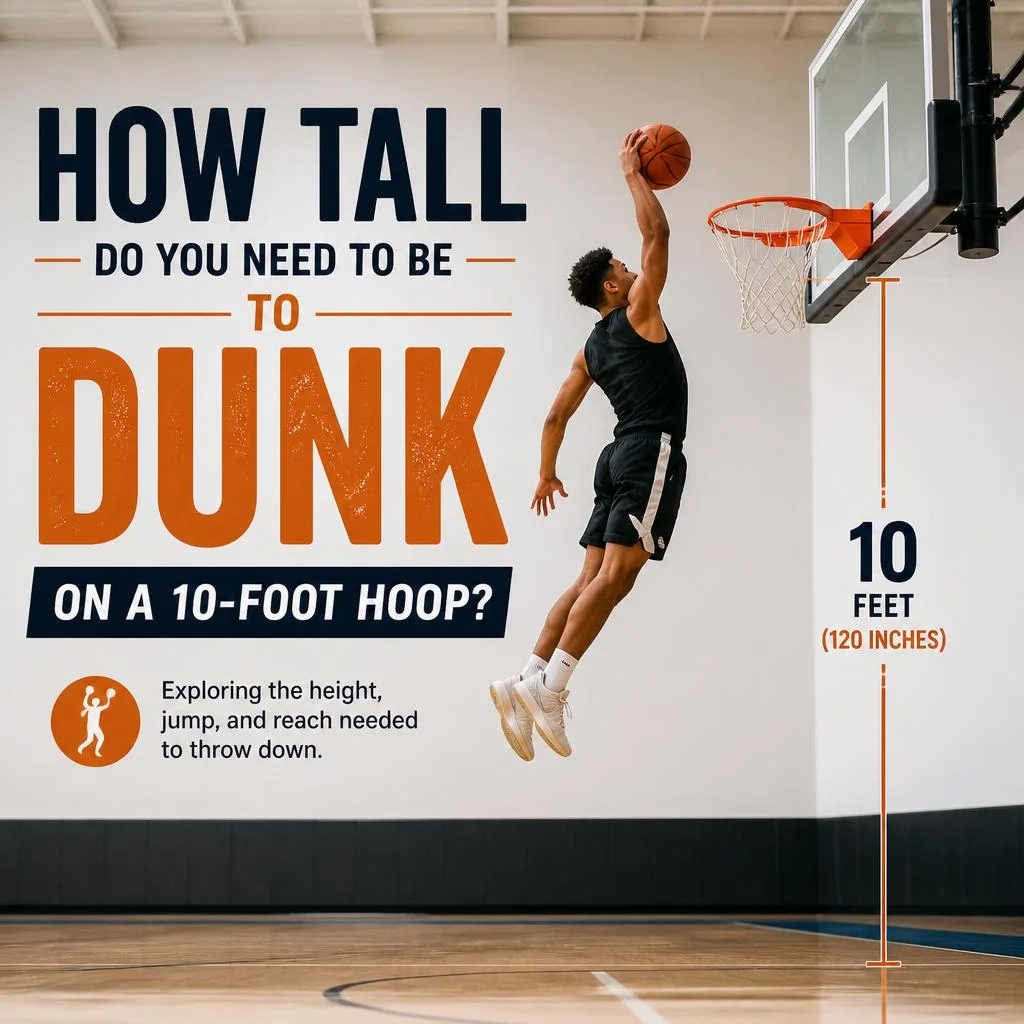
There is no single minimum body height for dunking a basketball. Dunking depends on standing reach, vertical jump, hand size, ball control, and the ability to get the ball above the rim.
A player who is 6 feet tall may dunk if they have enough jumping ability and reach. A taller player may still struggle if they cannot jump high enough or control the ball while airborne.
To understand the challenge, consider the basic measurements:
- Regulation rim height: 10 feet, or 120 inches.
- A player’s standing reach: The height they can touch while standing flat-footed and extending one arm.
- Vertical jump: The additional height a player gains by jumping from their standing position.
For example, imagine a player has a standing reach of 7 feet 10 inches. The top of the rim is 10 feet, so the player must rise at least 26 inches just to reach rim level.
However, touching the rim is not the same as dunking. The player generally needs additional clearance to control the ball and push it down through the basket. The amount needed varies with hand size, ball control, and technique.
This is why standing reach can be more useful than body height alone when estimating dunk potential.
Why NBA Players Make Dunking Look Easy
Professional players combine years of training with exceptional athletic ability. Many have high vertical jumps, strong coordination, and extensive experience controlling the ball near the rim.
Their approach also matters. A well-timed run-up can help a player jump more effectively, while controlling the ball in one hand may be easier for some athletes than managing it with both hands.
Still, not every NBA player dunks in every game. Basketball rewards many different skills, including shooting accuracy, passing, defense, and decision-making. A player does not need to dunk to become an excellent scorer.
How Far Is the Basketball Rim From the Floor During a Jump Shot?
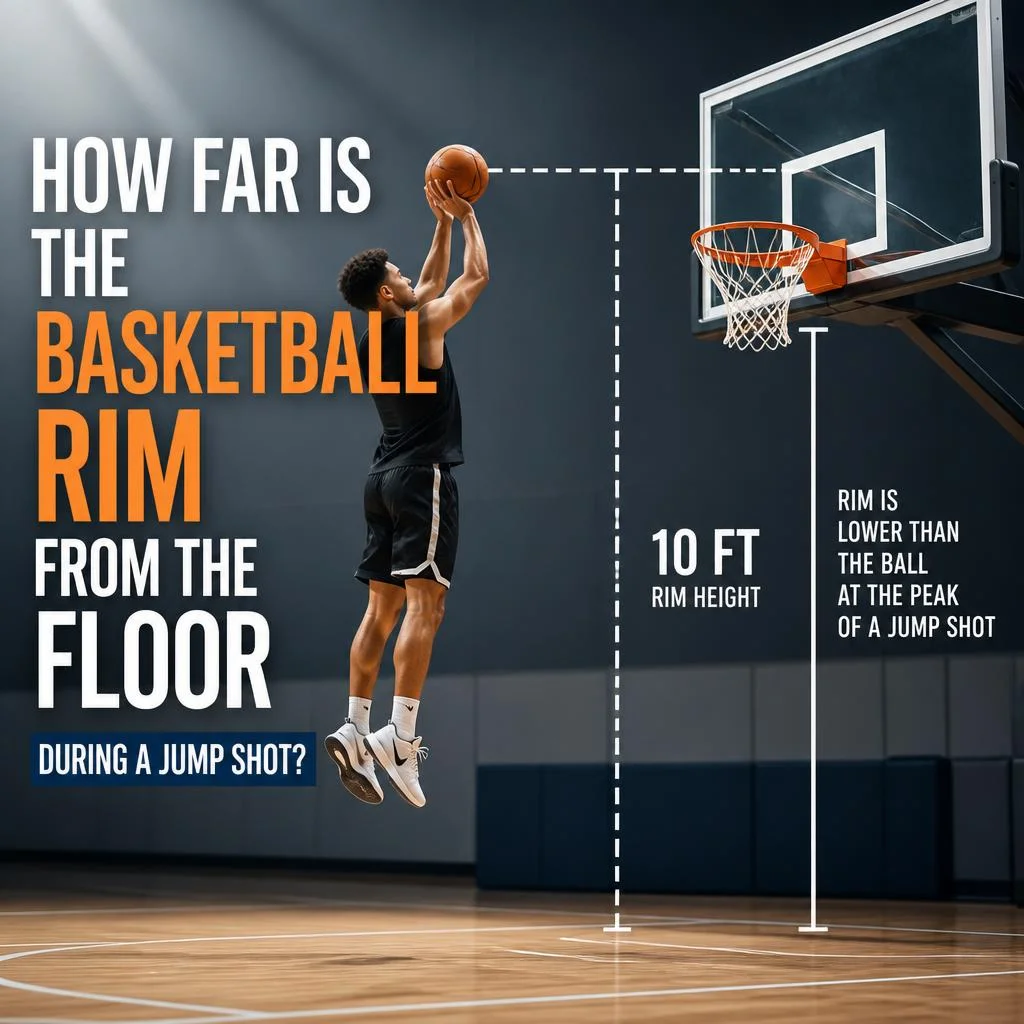
The rim remains 10 feet high whether a player is standing, jumping, or shooting from outside the three-point line. What changes is the ball’s release point and its flight path.
A jump shot gives a player a higher release point than a shot taken while standing flat-footed. That can help the ball clear a defender and create a better shooting angle.
After release, the ball travels along an arc before reaching the basket. The shooter must account for distance, force, angle, and spin. A higher arc can allow the ball to enter the rim at a steeper angle, while a flatter trajectory may leave less room for error.
The same fixed rim height therefore presents different challenges depending on where the shot begins. A close-range layup, a mid-range jumper, and a long three-pointer all target the same basket, but they require different techniques.
How to Measure an NBA-Height Basketball Hoop at Home

If you have a basketball hoop in your driveway or backyard, you can check whether it is set to regulation height with a tape measure.
Follow these steps:
- Choose a level playing surface. Make sure the area under the basket is reasonably flat.
- Find the top of the rim. The metal ring is the correct reference point.
- Measure vertically from the ground. Keep the tape measure straight rather than following the angle of the support pole.
- Check the result. The distance should be 10 feet, or 120 inches.
- Adjust the hoop if necessary. If the system has a height-adjustment mechanism, follow the manufacturer’s instructions.
For an adjustable portable hoop, check the manufacturer’s markings and locking mechanism before playing. Make sure the base is stable and that all adjustment pins are securely in place.
Do not climb on the rim or hang from it to test the installation. That can damage the system and create a risk of injury. If you are installing a wall-mounted or in-ground system, follow the installation guide and use appropriate assistance.
Common Measurement Mistakes
A few simple errors can lead to an incorrect reading:
- Measuring to the top of the backboard instead of the rim.
- Measuring along a tilted pole instead of vertically from the floor.
- Taking the measurement from uneven ground.
- Forgetting that the net hangs below the rim.
- Assuming every adjustable hoop is set to 10 feet because it looks regulation height.
A tape measure provides a much more reliable answer than judging the height by eye.
Does the NBA Change Hoop Height for Different Players?
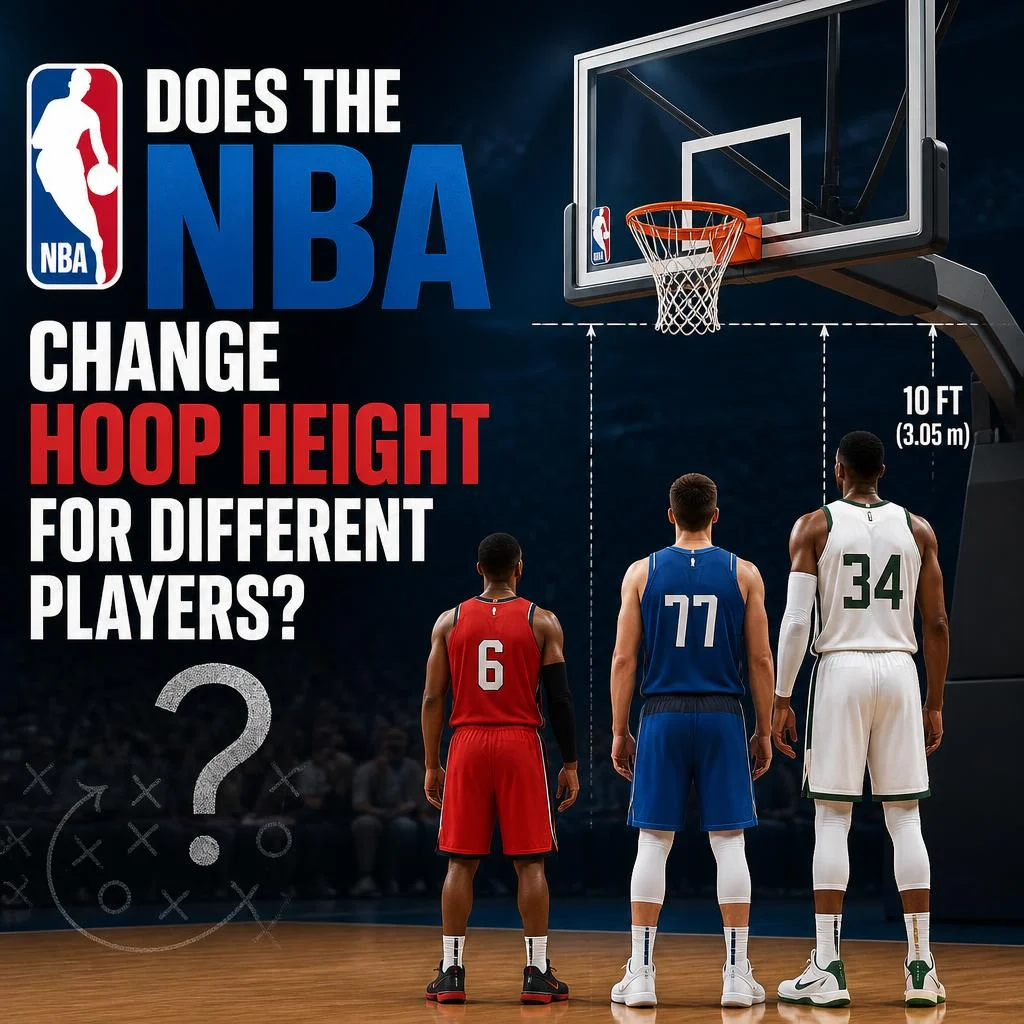
No. The NBA does not lower or raise the basket to accommodate individual players. Every player competes against the same regulation rim height.
This consistency is important for fair competition. Teams prepare for games knowing the basket dimensions will remain standard. Players develop shooting, passing, and finishing skills around those fixed conditions.
A shorter guard and a taller center may approach the basket differently, but both face the same target. Guards often rely on ball handling, quick releases, and shooting range, while taller players may have advantages near the rim. Neither position receives a different hoop height.
The same principle applies to free throws and three-point shots. The basket does not move; the player changes position and technique.
Why Does NBA Hoop Height Matter for Shooting Accuracy?
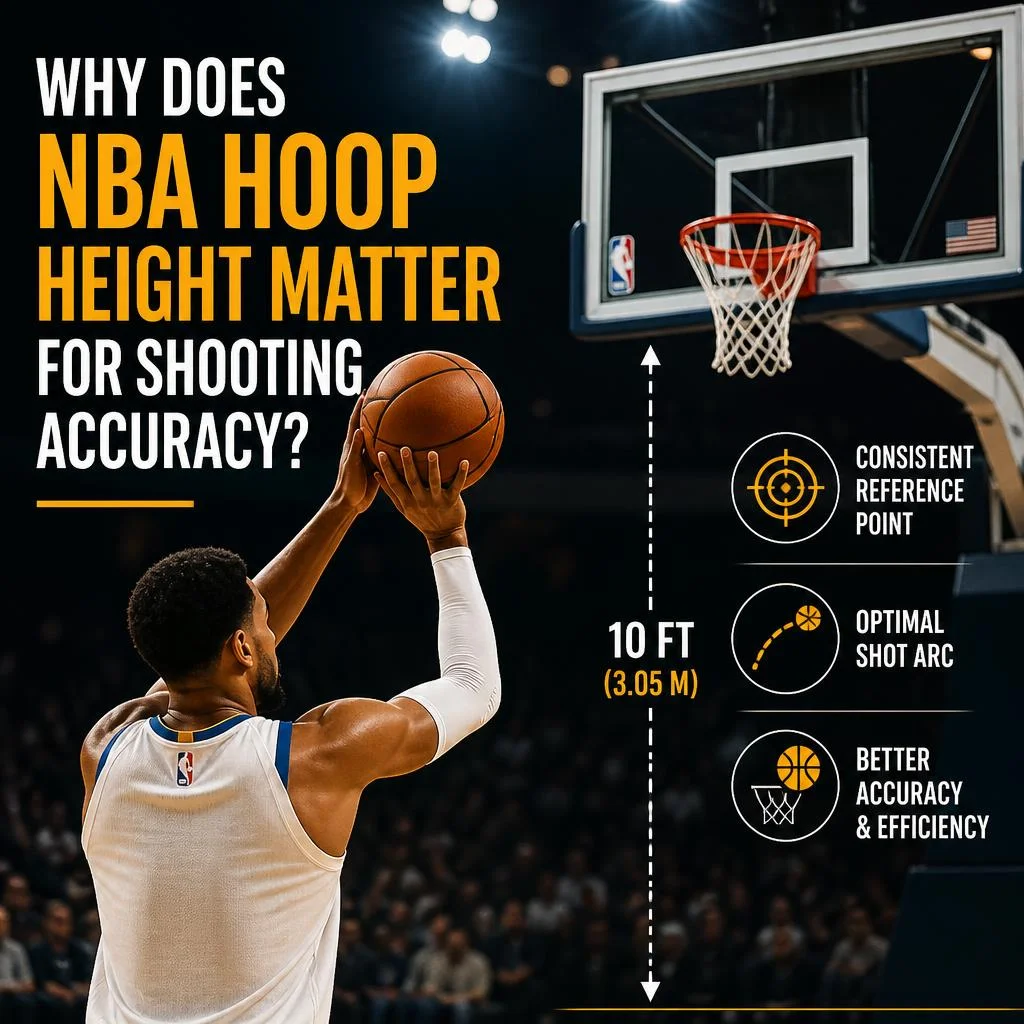
A basket’s height influences the mechanics of every shot. Players need to control the ball’s direction and force so it reaches the rim at a useful angle.
When practicing, players often work on several connected skills:
Release point: Releasing the ball consistently helps improve control. A stable release reduces unnecessary variation between attempts.
Arc: The ball needs enough height to clear the front of the rim while still descending toward the opening.
Distance control: A shot from farther away requires a different amount of force than a close-range attempt.
Follow-through: Extending the shooting arm and finishing with the wrist can help players repeat the same motion.
Footwork and balance: A balanced body position can make it easier to produce a consistent shot, especially under defensive pressure.
Because the rim height stays fixed, players can compare their performance over time. They can practice from the same spots, record their results, and identify which adjustments improve accuracy.
Frequently Asked Questions About NBA Hoop Height
1. Is an NBA hoop exactly 10 feet high?
Yes. The regulation rim height is 10 feet, measured from the playing surface to the top of the rim. This is equal to 120 inches or 3.048 meters.
2. Is NBA hoop height 10 feet or 10.5 feet?
The standard height is 10 feet, not 10.5 feet. A hoop may look higher in a large arena because of the camera angle, surrounding court, or the height of the players.
3. How many inches high is an NBA basketball hoop?
An NBA hoop is 120 inches high. This measurement refers to the top of the rim above the playing surface.
4. How many centimeters is an NBA hoop?
The standard height is 304.8 centimeters. It is commonly rounded to 305 centimeters or 3.05 meters.
5. Is the NBA hoop higher than a college basketball hoop?
No. Both NBA and NCAA basketball use a 10-foot rim height. Differences between these competitions include certain court measurements and rules, rather than the height of the basket.
6. What is the diameter of an NBA basketball rim?
The inside diameter of a regulation basketball rim is 18 inches. This opening allows a regulation basketball to pass through while still demanding accurate shooting.
7. Is the NBA backboard 10 feet high?
No. The rim is 10 feet above the floor. The backboard is a separate rectangular structure, typically 6 feet wide and 3.5 feet tall in NBA play.
8. Can a 5-foot-tall person dunk on an NBA hoop?
It is extraordinarily difficult for someone who is 5 feet tall to dunk on a 10-foot rim, because doing so requires exceptional jumping ability relative to their standing reach. Body height alone does not determine dunk potential, but the physical challenge is substantial.
9. What height should a basketball hoop be for a child?
There is no single ideal height for every child. Some youth programs use rims between 5 and 8 feet for beginners, while older or more experienced children may practice on a 9- or 10-foot basket. Follow the recommendations of the relevant league or coach.
10. Does the hoop height include the net?
No. The 10-foot measurement is taken to the top of the metal rim. The net hangs below it and does not determine regulation height.
11. Why do some basketball hoops look taller than others?
Perspective can make a hoop appear taller or shorter. Camera position, court layout, surrounding structures, and the height of nearby players can all affect how the basket looks. The regulation rim height remains 10 feet.
12. Has the NBA always used a 10-foot hoop?
The 10-foot height traces back to basketball’s early history and the gymnasium railing used when James Naismith introduced the sport. The standard persisted as the game developed into the modern professional competition.
Final Thoughts
The official NBA hoop height is 10 feet, or 120 inches, above the playing surface. The same standard applies across NBA arenas and matches, creating a consistent target for every player.
The rim is only one part of the setup. A regulation basket also includes an 18-inch inside-diameter rim and a backboard measuring approximately 6 feet wide by 3.5 feet tall. Together, these dimensions influence shooting angles, rebounds, layups, and dunks.
Whether you are a basketball fan, a young player, or someone setting up a hoop at home, knowing the correct measurements helps you understand the game and practice under realistic conditions. The next time you watch an NBA player rise for a dunk or sink a long jumper, remember that every shot is aimed at the same 10-foot target.

Aiden Cross is a passionate writer dedicated to exploring creativity, style, and modern trends through engaging and informative content. His goal is to provide readers with practical insights and fresh perspectives.